
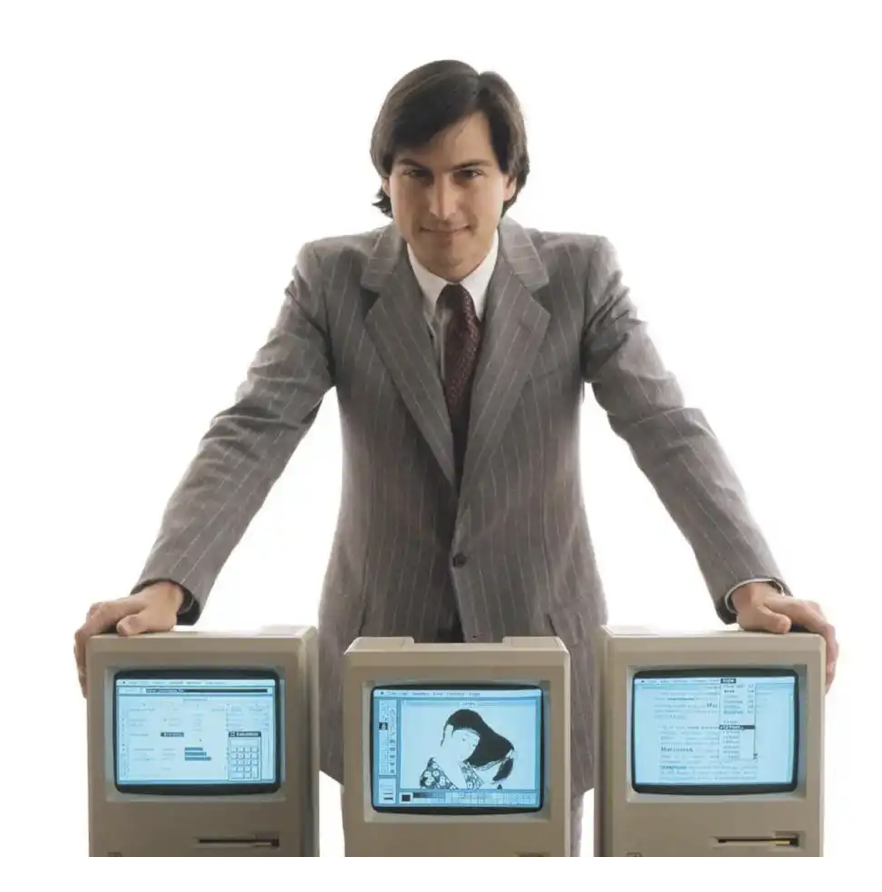
Whether you are a fan of Apple and its products or not, take a step back and think about what reality would look like today without Steve Jobs and Apple. What would it look like if the Macintosh was never created?
In some way this is a specious argument: graphic interfaces and mice were known in some areas of the tech universe before Apple. Cellular phones existed before Apple as well. But what Steve and Apple did with the Mac was take what were at the time esoteric technical ideas and turn them into something accessible and usable by the general public — and then convince the public that it was the thing they wanted.
That’s the thing critics of Steve tend to forget: his true innovation wasn’t in inventing the Mac and the graphic interface, it was in making it a mainstream and accessible product — he took these ideas and sold them to the world.
What would computers look like today if that hadn’t happened? The graphic interface seems inevitable in hindsight, but who would have championed it and how would it be different today?
What would it look like if the iPhone had not been created? Cell phones existed, but they were — phones — with limited tools and funky keyboards. With the iPhone, Steve and his team reinvented something that at the time was functional but not interesting, useful in limited ways but still very much a phone.
The iPhone turned your phone into a true personal assistant, the kind of thing Palm and Newton wanted to be but never fully realized. What would our phones look like today without the iPhone? Would they all be Blackberry clones?
The core skill Steve brought to the world was his ability to see — seemingly by pure intuition — how to turn pieces of technology into things that would change our lives for the better, and how to push the teams that worked for him to implement that vision, and most importantly, how to explain that technology to the general public in a way that convinces the public that they want that technology to be a part of their lives.
An important reality I learned spending 40+ years in the high tech industry: the technology is the easy part (and it’s not easy). What’s hard is understanding how to convince others they want that technology in their lives. Remember when the future of home theaters were those 3D televisions? The last 50 years of high tech innovations is littered with massively hyped “the future of” products that were received with a yawn and disappeared without a trace.
Steve understood this. Steve understood how to get people excited and engaged with things. Innovative and interesting technology isn’t the solution, it’s the table stakes that lets play the game. Steven got that.
So…. Steve.
Talking about Steve is complicated. Steve was a very complicated man. He had one of the sharpest minds I’ve ever seen in action — he picked up on ideas and nuances as fast as I’ve ever seen anyone, and could jump to the end game while everyone else in the room was still trying to understand what was being talked about.
That said, sharp things can cut and injure, and that was also Steve. Steve had a reputation for being tough to work for, and that reputation was justified. Steve burnout was a real thing, and some people couldn’t or wouldn’t thrive in close proximity to Steve. At the same time, though, there are many people who did thrive in orbit around Steve, and went on to build things that changed the world around us for the better.
And there are times when Steve would say things that would blow you away and change how you view the world. I recommend to you this video of his 2005 Stanford Commencement speech, which I think is a nice example of Steve at this best.
After Steve came back to Apple, I ended up orbiting him. He would have known my name and the work I was doing, but it’s unlikely he would have recognized me in person — I was typically one person away from him and dealt with the people that dealt with him. This was close enough to see how he operated and what people said and thought about him, but never so close that I had to deal with Steve’s intensity directly. That was, for me, optimal working conditions.
My take on Steve is that he was at times difficult to work with, but it’s because he set a high expectation on results. Unlike many other CEOs and bosses I’ve watched over the years, Steve set expectations on himself at least as high, and often higher, than he did on those around him. He was driven, he was involved in (sometimes obsessed by) tiny details that a CEO of a company should not be spending time on.
For example, one launch day our team sat around for a solid 45 minutes while Steve tried to decide if one sentence in a marketing email should have a comma in it or not (final answer: yes). This was after a full day of presenting the keynote and a full suite of press interviews and coverage that an Apple product launch day included. Should he have been putting in that time? In my view, absolutely not — he’d had a huge day already, and here we are, 15 hours after the start of the keynote, and he’s reviewing emails. But that was Steve: he knew details mattered, and he was often terrible at allowing himself to delegate. But that focus on even the smallest detail was something he made a priority, and that instilled that level of detail in all of those around him, and I think that’s a significant aspect of how he turned Apple around and made it the powerhouse it is today.
On a personal level, Steve helped create a series of products that are deeply embedded into my life, and a company that I spent almost half my high tech career in, and which allowed me to help that company reshape society and make it (I believe) a better world than it would have been without Apple and Steve.
Steve taught me many lessons both positive and negative. I still aspire to the level of detail in my own creation that he expected, but I also looked at how he treated others at times, and decided that this wasn’t the way I wanted to treat others.
So, yeah. When you ask me to tell you about Steve, I stare into the distance for a bit, sigh, and then I’ll start with “well, it’s complicated”.
Apple at 50 elsewhere
A couple of quick notes about Apple at 50 things going on elsewhere.
I rarely read books about Apple these days, because, well, I lived it, and do I really need to be told about what I lived? Beyond that, there have been too many that are badly written, or clearly hatchet jobs — or simply wrong (I mean, seriously: I was there when that happened).
But there are some interesting things being written about Apple and I wanted to point one out to you: David Pogue, who’s been writing about Apple and the High Tech industry almost as long as I’ve been in it has published his book about apple:
Apple: The First 50 years is a biography of Apple. I’m about a third of the way through it and it’s really good, full of detail but not overladen. Well researched and surprisingly, with cooperation by Apple, if there’s one thing to read about Apple in this anniversary year, this is it. Jason Snell (of Six Colors) wrote a nice review of it for the Wall Street Journal that also brings a nice perspective to the work and Apple. Jason also interviewed Pogue in a recent episode of his podcast Upgrade which I also recommend to you.
As I run across other things of interest I’ll share those with you. I know Jason is planning some things as well, but as I write this, he hasn’t started sharing them yet.